


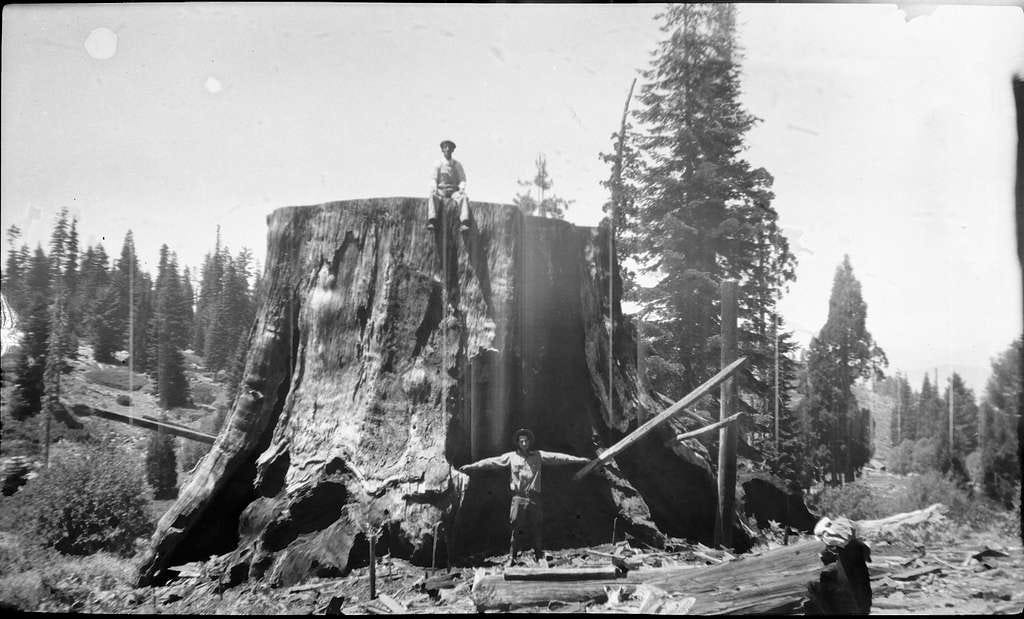
While I was in the area for my recent 50-mile hike through Kings Canyon National Park, I took a few hours to drive up a long dirt road and visit a place with a dark and painful history, especially for those of us who love California’s magnificent sequoias. The place is called Converse Basin Grove, and it was the site of what some have called one of the worst human-caused environmental catastrophes in U.S. history. I’ve been fascinated by its story ever since I first read Jared Farmer’s excellent book, Trees in Paradise: A California History.
It’s not just a story of greed, although it is that. It’s also a story of staggering short-sightedness, a complete lack of appreciation for some of nature’s most magnificent organisms and, as ecologist Andrew L. Rypel put it recently in his excellent post, the Abundance Trap. That’s the idea that when something is plentiful, we assume it will always be there and place less value on it. Rypel points to the senseless slaughter and eventual extinction of the passenger pigeon. Like Converse Basin, it is another sickening example of how human avarice and thoughtlessness can destroy what once seemed inexhaustible.
Covering more than 4,600 acres, Converse Basin was one of the largest giant sequoia groves on Earth, if not the largest. Before it was logged, the basin held an estimated 8,000 mature giant sequoias and was considered the densest concentration of these trees ever known.
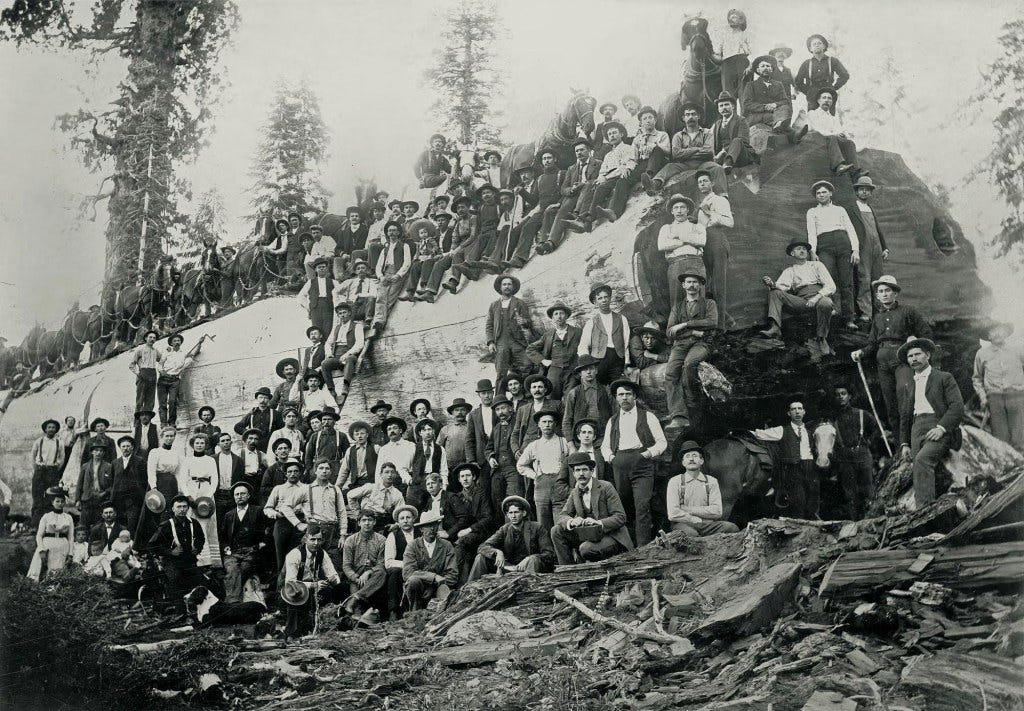
From the early 1890s through 1908, the Kings River Lumber Company and its successors logged the grove using sloppy, ruinous clearcutting practices, and cut down nearly ALL the trees, some of them over 2000 years old, in an event that has been described as “the greatest orgy of destructive lumbering in the history of the world.” Only 60-100 large specimens survived. Only one true giant survived. One.
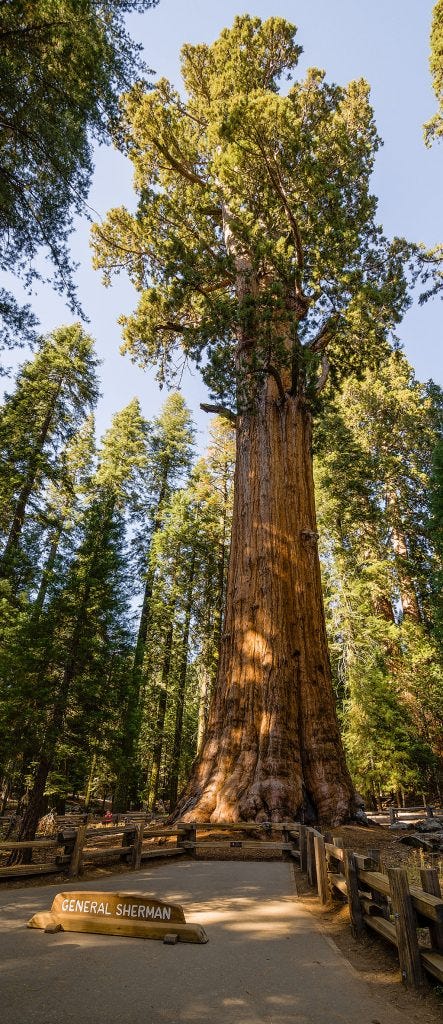
Currently, the largest remaining sequoias can be found in the adjacent Giant Forest in Sequoia National Park, which I visited beforehand and has an estimated 8,400 giant sequoia trees that are more than one foot in diameter at their bases. The park is home to the world’s biggest tree, the General Sherman.
So keep this in mind as you follow the story: in a relatively short period of time, one company cut down roughly 8,000 mature giant sequoias, a number comparable to the entire sequoia population of Giant Forest today. And it gets worse. As you’ll read below, or see in the video above, the company never made a profit, and most of the wood was shattered, wasted, or left to rot. Much of what could be salvaged became fence posts, shingles, and grape stakes.
So how did this happen? The Converse Basin grove’s discovery in the late 19th century coincided with a burgeoning demand for lumber in the wake of California’s Gold Rush and subsequent population boom, particularly in San Francisco. A huge portion of early San Francisco was built using redwood. In fact, redwood was the dominant building material in much of 19th-century California, and San Francisco was practically a redwood city. (That’s another tragic story.)
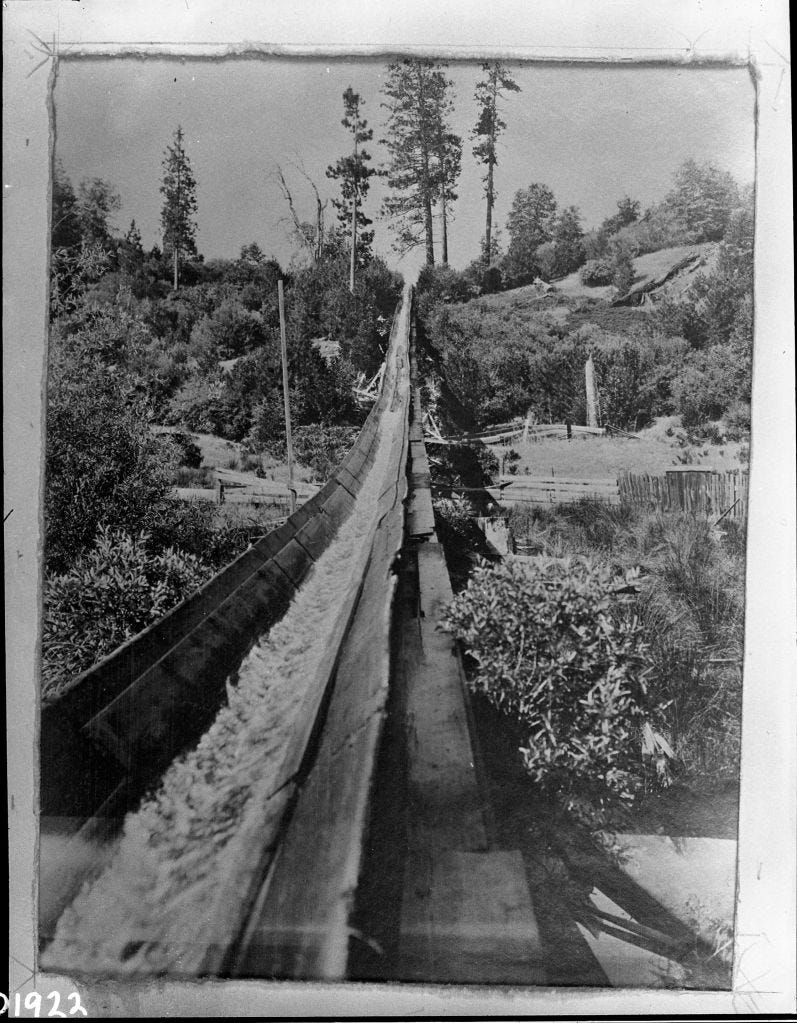
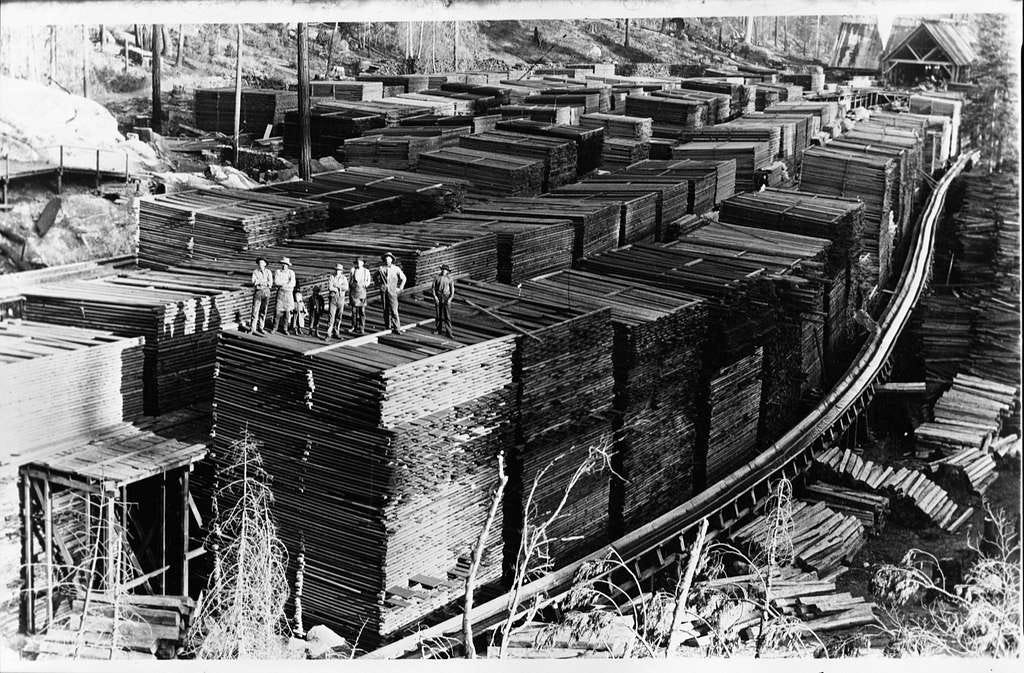
This demand drew loggers to the enormous volume of timber inside the giant sequoias, even though their brittle wood was poorly suited for structural construction. In particular, the land drew the attention of the Kings River Lumber Company, which incorporated in 1888. But the trees stood high in a remote and largely inaccessible basin. Logging them on an industrial scale required enormous investment, much of it financed through debt. The company had to build a mill in the mountains, along with rail lines and a massive flume to carry the processed lumber down to the Central Valley. It became the first industrial-scale logging operation to target the Sierra’s giant sequoias.
Interesting fact: the massive flume later inspired modern amusement park log rides like the Timber Mountain Log Ride at Knotts Berry Farm in Southern California.
But how could one company acquire so much public land? By exploiting a federal law meant to put land considered unsuitable for farming into many private hands and, surprise, surprise, using outright fraud to get around its limits.
The Timber and Stone Act of 1878 allowed individuals to purchase public land valuable primarily for timber or stone. Each buyer could acquire up to 160 acres for $2.50 an acre but had to swear that the land was for personal use, not speculation, resale, or purchase on behalf of a company. On paper, that restriction prevented lumber companies from accumulating enormous tracts of public forest. In practice, it created an opportunity for a massive illegal land grab by a single company.
To claim these 160-acre parcels, the claimant only needed to attest that their intention was to utilize the land for practical, non-speculative purposes.
But the Kings River Lumber Company exploited the Timber and Stone Act through a scheme known as “dummying.” It paid stand-ins, or “dummies,” often poor rural folk, to claim 160-acre parcels for personal use and then transfer the land to the company. They were not paid much. Repeated again and again, the scheme allowed the company to amass vast tracts of old-growth sequoia forest while evading federal limits on land purchases.
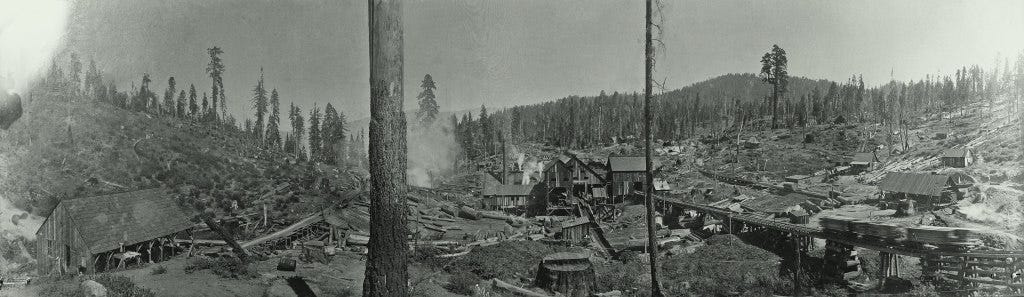
Lumber production began in Converse Basin in 1891, sending cut trees (initially mostly pine, fir, and cedar) down the flume. But because the company had been created through the issuance of massive debt, it was under pressure to increase output to become profitable. The directive was cut, cut, cut to stay afloat. But it wasn’t enough.
And so the firm was taken over by creditors and renamed Sanger Lumber. The new management pushed again for maximum production, extending the narrow-gauge railroad deeper into the basin and constructing a new sawmill in 1897.
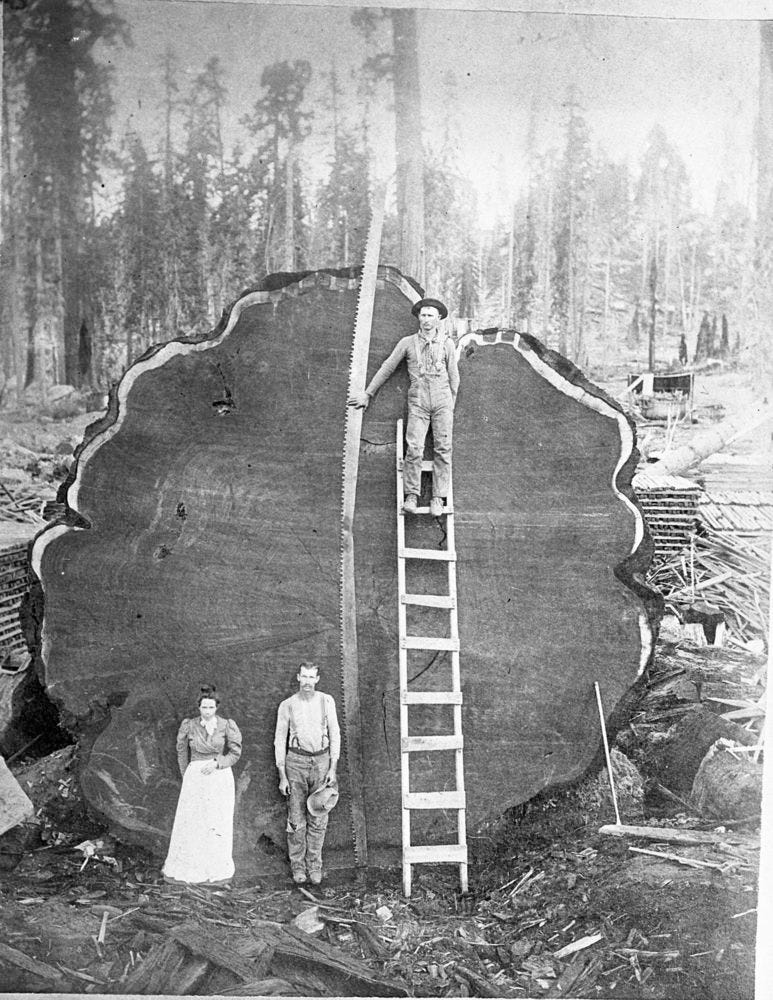
In little more than a decade, Sanger Lumber felled perhaps 8,000 mature sequoias across Converse Basin. Only one of the grove’s truly great giants survived: the Boole Tree, named for company manager Frank Boole, who is said to have ordered it spared. (I could not find confirmation of this). More than 2,000 years old, it remains the largest tree in America’s national forests.
But the destruction was also an exercise in staggering waste. Giant sequoia wood is brittle and poorly suited for structural lumber. Many trees shattered when they hit the ground, and federal estimates put the operation’s total efficiency at only 25 to 30 percent. Much of the usable wood, again, became fence posts, shingles, and grape stakes. After all that, the company never turned a profit.
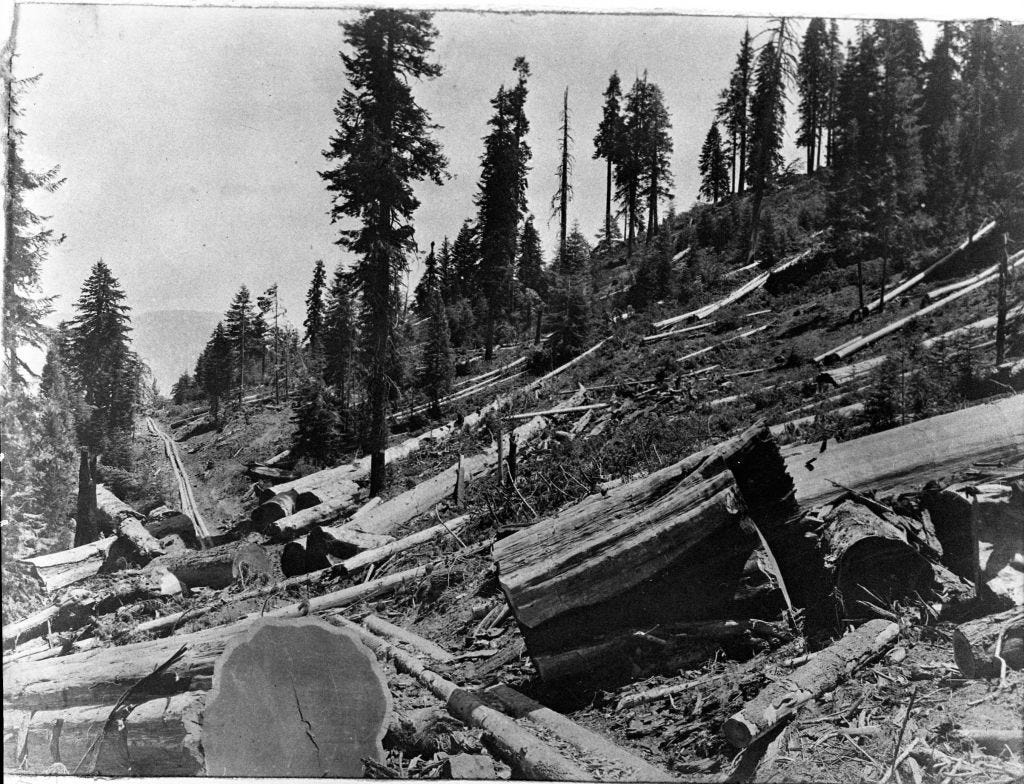
The entire operation ended with the sale of the company in 1905 and the eventual destruction of the Converse Basin mill. What followed was a period of secondary logging, akin to scavenging, that persisted into the 1910s. In a Harpers’ essay titled The Last Stand of the Redwoods, the Yale English professor Henry Seidel Canby wrote that a visit to the basin evoked a deep sense of melancholy, describing what he saw as “a vast and lonely cemetery”.
As I mentioned above, I had just spent time walking among the jaw-dropping, awe-inspiring giants of Sequoia National Park, where trees like General Sherman and the President rise from the ground like buildings. Then I walked among the stumps at Converse Basin with my friend James and flew my drone overhead. We had the place entirely to ourselves, apart from a ranger who drove past on his way to an inspection. Knowing the story, I was filled with powerful feelings of anger and loss.
Imagine 8,000 giant sequoias packed into this one basin. My God, what a place it must have been! And then they cut them down until only one of the grove’s great giants remained.
One freaking tree.
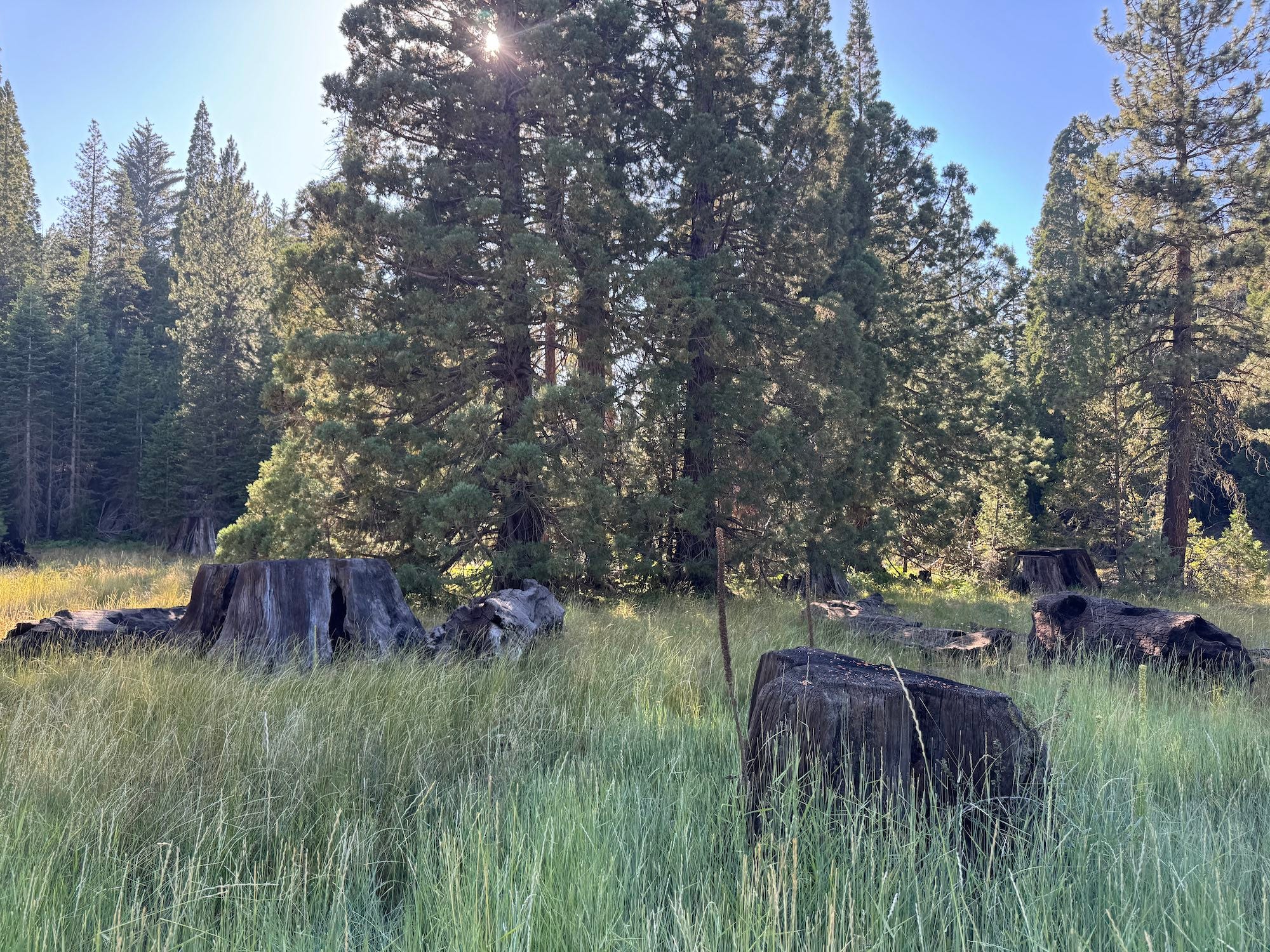
The good news, if that’s possible, is that the devastation of Converse Basin helped to jumpstart the conservation movement in the early 20th century. Galvanized by the widespread destruction of such majestic trees, a new breed of conscientious naturalists and conservationists, led by figures like John Muir, began to advocate for the protection of these natural landscapes. Their efforts helped establish later national parks and protected areas, ensuring that other groves and natural habitats were spared from the fate of Converse Basin.


